Key numbers
1What MSCI is and how it moves money
Slides 3-12MSCI’s tiers decide which funds must own a market; Standalone sits in no regional index
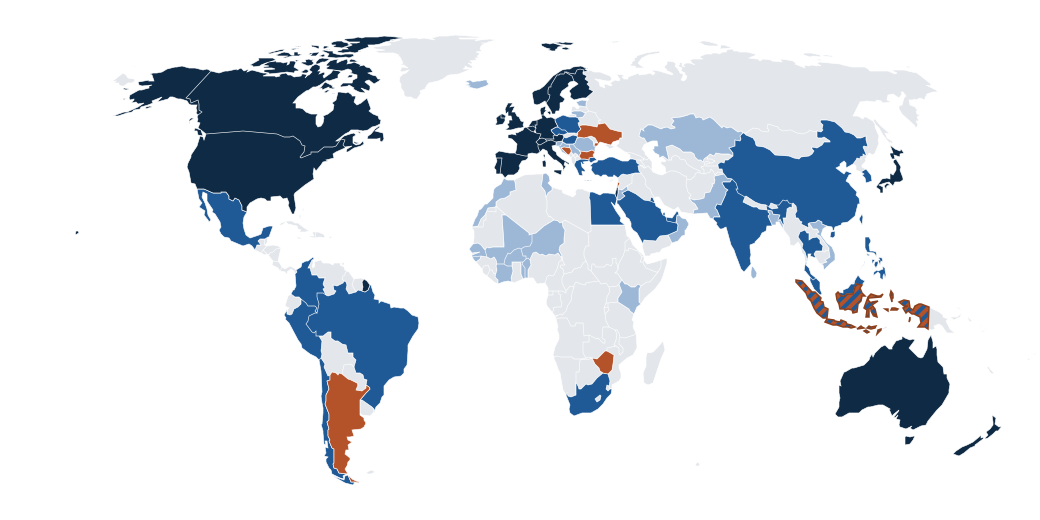
Weight = tradable value ÷ index value: $53.4bn ÷ $12.28tn = 0.43%
A country’s weight follows its tradable market value. Each 0.1 point of EM weight is about $1.3bn of index-tied money. Index funds must sell on the effective date; active funds measured against the index usually follow.
2Why Standalone, and what 2026 has done
Slides 7-8, 13-16Four MSCI steps in nine months; the IHSG fell from 8,647 to about 5,200
- 1 · 27 JanData warning; index changes frozen. IHSG −7.35% on 28 Jan.
- 2 · 23 JunInformation-flow rating cut at the annual review.
- 3 · 12 AugCPIN and GOTO removed; 9 stocks left and a 0.43% weight.
- 4 · 15 OctStandalone proposed; IHSG −11.6% the next day.
Feedback reported by MSCI says Frontier “would not properly recognize the depth of the market problems”: opaque ownership, suspected coordinated trading, reforms applied unevenly and little visible enforcement. Indonesia passes the size test; it fails on information flow and price formation. MSCI will judge enforcement, not announcements.
3Scenarios to June 2027
Slides 17, 23-24, 31Standalone is our base case at 50%; the weighted IHSG is about 4,710
Select an outcome. Ranges come from price-to-earnings bands for the nine MSCI stocks; the rest of the market moves at 0.8 times. Probabilities are Sulco judgement; the basis for each is below.
Bar = range; dot = mid; vertical line = today, about 5,200.
D. Moved to Standalone
The proposal goes ahead; no regional or global index holds Indonesia.
- IHSG mid
- 3,830
- Range
- 3,550-4,110
- USD/IDR
- 19,500
- Index-linked flow
- −$11.6bn
How the scenario odds are set
Each probability is Sulco judgement, anchored on what MSCI has said and on the six MSCI downgrade consultations since 2012 (Greece, Morocco, Argentina, Pakistan, and Nigeria twice).
| Scenario | Odds | Basis |
|---|---|---|
| A. Reforms accepted | 15% | MSCI stood down in 1 of 6 past cases (Nigeria 2017, after a policy fix during the consultation). Needs market-wide enforcement evidence by 30 Apr 2027. |
| B. Status quo | 25% | MSCI has deferred or extended when reforms were part done: Nigeria’s decision was deferred in 2017, and its 2022-23 review ran about 16 months. |
| C. Frontier | 10% | MSCI used Frontier for size and liquidity problems (Morocco 2013, Pakistan 2021) and Standalone for access problems (Argentina 2021, Nigeria 2023). Indonesia’s issue is access; the paper still asks about Frontier. |
| D. Standalone | 50% | MSCI “expects to proceed” without clear evidence of material improvement, and 5 of 6 past cases ended in a downgrade. Discounted because the fix, enforcement and ownership data, is in OJK and IDX hands and reforms are under way. |
Together, a downgrade of some kind is 60% (C plus D), against about 80% in past cases. Moving 10 points between Standalone and status quo shifts the weighted IHSG by about 140 points. Detail and sources in the methodology note.
Weighted across the four outcomes, the IHSG is about 4,710, 9% below today. A scenario range, not a price target.
4Foreign flows
Slides 18-20About $11.6bn of index-linked selling under Standalone, $17.4bn with other foreign money
Standalone, USD bn
Active = 75% of about $8bn held. Other = 10% of about $58bn of non-benchmarked foreign money. Danantara: $5bn case of a reported $3-5bn, unconfirmed. Frontier would mean $11.1bn gross.
Published estimates of index-linked selling, USD bn
Light shading: stress case, FTSE add-on, top of range or, for Sulco, all foreign money. *Includes bonds. Estimates differ mainly in what they count.
Index funds must sell everything; active funds usually follow. On passive selling we use Goldman’s $5.6bn, the top of the published range; the gap to other estimates is active and non-benchmarked money.
5Who sells, who buys
Slides 21-22Domestic buyers cover 42-53% of supply; the four big banks take ~74% of selling in the nine MSCI stocks
Supply vs identified demand to Nov 2027, USD bn
Supply19.6
Free-float sales 2.2
Identified demand8.3-10.3
Danantara 3-5Buybacks 2.3BPJS TK 1.6Others 1.4
Forced selling in the nine MSCI stocks (dark = banks)
Split by estimated MSCI weight. The other ~$1.4bn falls on the 10 Small Cap names and holdings outside the nine.
The gap clears through retail buyers and lower prices.
6The rupiah and Bank Indonesia
Slides 26-29A weaker rupiah deepens dollar losses; reserves can absorb the base case at a cost like 2013 and 2018
IHSG by outcome and rupiah level · % = return in US dollars
| USD/IDR | 17,500 | 18,200 | 19,000 | 20,000 | 21,500 |
|---|---|---|---|---|---|
| A. Reforms | 6,980 +39% | 6,830 +31% | 6,620 +22% | 6,360 +11% | 5,980 −3% |
| B. Status quo | 5,310 +6% | 5,200 0% | 5,040 −7% | 4,850 −15% | 4,580 −26% |
| C. Frontier | 4,770 −5% | 4,670 −10% | 4,540 −16% | 4,370 −24% | 4,130 −33% |
| D. Standalone | 4,090 −18% | 4,010 −23% | 3,900 −28% | 3,760 −34% | 3,560 −42% |
FX reserves used in past defences vs possible outflow now, USD
Outflow = equities 17.4 + SRBI 1.6-3.2 + SBN 1.5-2.5. Bank Indonesia held 5.75% on 21 Oct; deposit facility 5.00%.
Each 1% rupiah fall adds about $0.3bn of selling. A $20-23bn outflow is 14-16% of $146.3bn of reserves, as in 2013 and 2018.
7Precedents and what to watch
Slides 25, 30-33Past cases were small and their price paths mixed; Indonesia’s passive outflow is ~7-9x Argentina’s
MSCI review: more deletions cut the weight
OJK and IDX enforcement; free-float compliance
FTSE review: following MSCI adds about $2.7bn
Consultation feedback closes
MSCI decision: the main price event
Past cases, USD returns: small markets, mixed paths
| Case | Month before | Decision to effective | Next 6 months |
|---|---|---|---|
| Argentina 2021EM → Standalone | +8.0% | −9.8% | +6.1% |
| Pakistan 2021EM → Frontier | −3.0% | −8.7% | −15.3% |
| Greece 2013DM → EM | −12.1% | +31.5% | +4.9% |
Indonesia's passive outflow ($4.0-5.6bn) is about 7-9 times Argentina's (~$0.6bn), so more of the move is likely to come early.
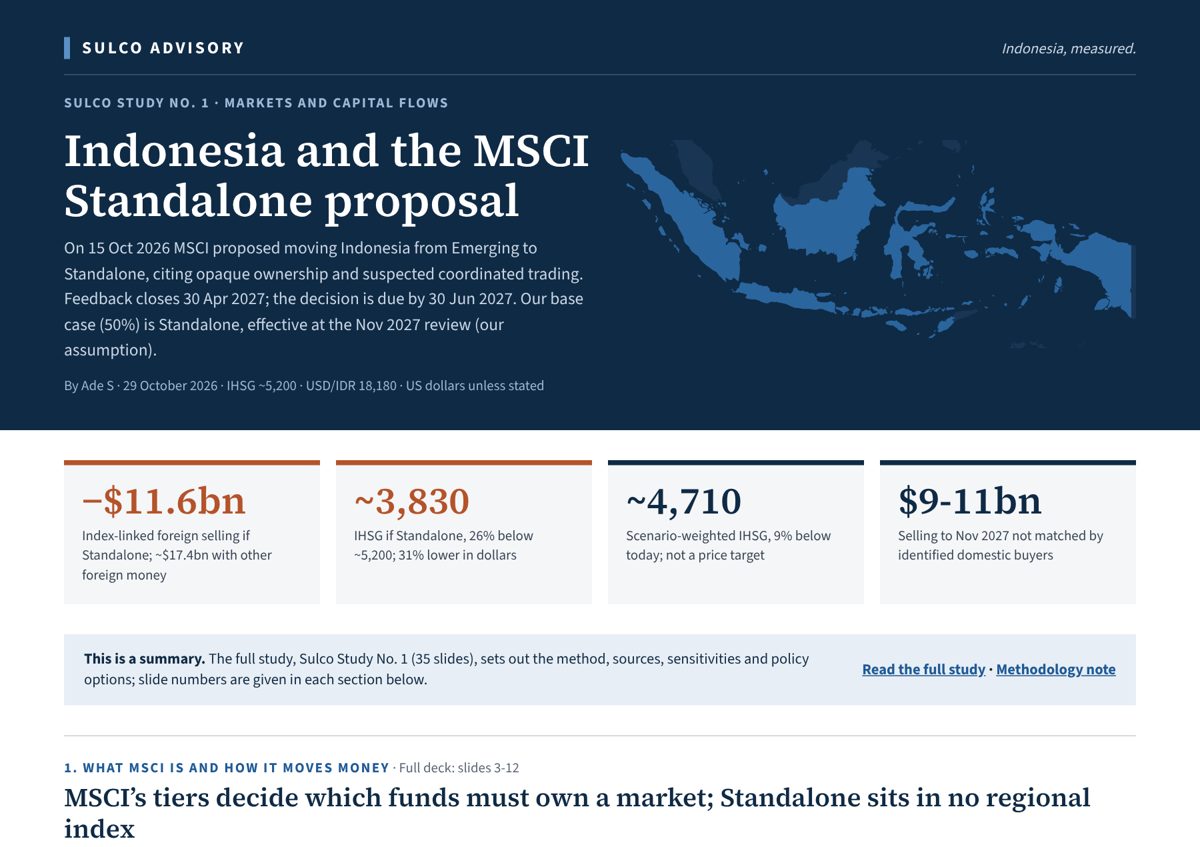
Summary · one long page
Share the summary
The seven sections on one scrolling page, made to read on a phone. It links back to this page and the full study. Free to share.
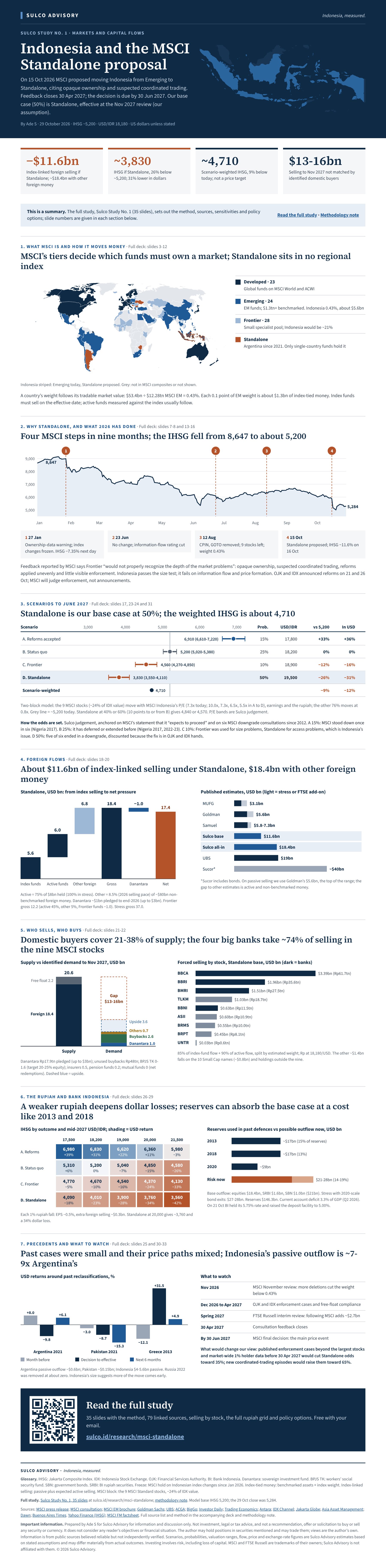
For print: A3 version (PDF).
Full study · 35 slides
Read the full study
Every exhibit behind the summary: the flow model, selling by stock, the full rupiah grid, Bank Indonesia's options, precedents, policy options and 68 linked sources. Leave your email and it opens on this page.
Thank you. The full study is open below. Tap a slide to view it full screen.
- 1-2Cover and executive summary
- 3-8What MSCI is and how it classifies markets
- 9-12How classification moves fund money
- 13-16What has happened to Indonesia
- 17-28Scenarios, stocks, the IHSG and the rupiah
- 29-35Wider effects, signposts, sources and disclaimer
Arrow keys or swipe to move. On a phone, turn sideways and use full screen.
Questions
MSCI and Indonesia: common questions
What is MSCI’s proposal for Indonesia?
On 15 October 2026 MSCI proposed moving Indonesia from its Emerging Markets index to Standalone status, citing opaque ownership and suspected coordinated trading. Consultation feedback closes on 30 April 2027 and a decision is due by 30 June 2027.
What does Standalone status mean?
A Standalone market is not part of any regional or global MSCI index, so funds that track MSCI Emerging Markets no longer hold it; mainly single-country funds do. Argentina has been Standalone since 2021.
How are the scenario probabilities set?
Each is Sulco judgement, anchored on MSCI’s statement that it expects to proceed and on six MSCI downgrade consultations since 2012. Reforms accepted 15% (MSCI stood down in 1 of 6), status quo 25% (MSCI has deferred or extended before), Frontier 10% (used for size problems, while access problems led to Standalone), Standalone 50% (5 of 6 ended in a downgrade, discounted because the fixes are within Indonesian regulators’ control).
How could a reclassification affect the IHSG?
Index funds that track MSCI Emerging Markets would have to sell their Indonesian holdings, and active funds measured against the index often follow. The study estimates the IHSG under four scenarios, from reforms accepted to Standalone, with a two-block valuation model set out in the methodology note.
Which Indonesian stocks are most exposed?
The nine stocks in the MSCI Indonesia index. The four large banks, BBCA, BBRI, BMRI and BBNI, account for about three quarters of the estimated index-linked selling.
What could it mean for the rupiah?
Foreign selling of Indonesian equities and bonds adds pressure on the rupiah. The study compares the possible outflow with Bank Indonesia’s US$146.3bn of reserves and with past episodes in 2013 and 2018.
Can the outcome still change?
Yes. MSCI has said it will judge enforcement rather than announcements. Published enforcement cases beyond the largest stocks, and market-wide data on holders above 1%, before 30 April 2027 would make a move to Standalone less likely.
Notes by step
How each number is built
Short versions of the working. The methodology note has the formulas, parameters and sensitivities.
- What MSCI is
MSCI is a private index company with no legal power; its weight comes from the funds that follow it. Weight = $53.4bn ÷ $12.28tn MSCI EM = 0.43%; each 0.1 point ≈ $1.3bn of index-tied money.
- What 2026 has done
IHSG 8,647 at end-2025, peak 9,135 (20 Jan), 5,284 on 29 Oct; −7.35% on 28 Jan. 12 Aug: CPIN and GOTO removed. OJK and IDX announced reforms on 21 and 26 Oct.
- Scenarios
Two-block model: the 9 MSCI stocks (~24% of IDX value) on the MSCI Indonesia P/E (7.3x today; 10.0x, 7.3x, 6.5x, 5.5x in A-D), earnings and the rupiah; the rest moves at 0.8x. USD/IDR 17,800, 18,200, 18,900, 19,500 in A-D. Standalone odds of 40% or 60% give 4,840 or 4,570.
- Foreign flows
Index 5.6 = Goldman passive estimate; active = 75% of ~$8bn held; other = 10% of ~$58bn non-benchmarked money; Danantara $5bn case (reported $3-5bn). Frontier gross $11.1bn; stress gross $34.9bn.
- Who sells, who buys
Supply = foreign selling 17.4 + free-float stage 1 2.2. Demand: Danantara 3-5 (reported), unused buybacks 2.3 (Rp42tn), BPJS Ketenagakerjaan 1.6, insurers, pension and equity funds 1.4. Stock split = 85% of index + 90% of active flow by estimated weight; Rp at 18,180.
- The rupiah and BI
Outflow = equities 17.4 + SRBI 1.6-3.2 + SBN 1.5-2.5. Each 1% rupiah fall cuts EPS 0.5%. Standalone at 20,000: IHSG ~3,760, −34% in USD. Current account deficit 3.3% of GDP (Q2 2026). BI held 5.75% on 21 Oct; deposit facility 5.00%.
- What to watch
Passive outflow: Argentina ~$0.6bn, Pakistan ~$0.15bn, Indonesia $4.0-5.6bn (~7-9x Argentina). Russia 2022 was removed at about zero. Indonesia’s size suggests more of the move comes early.
Glossary
- IHSG
- Jakarta Composite Index
- IDX
- Indonesia Stock Exchange
- OJK
- Financial Services Authority
- BI
- Bank Indonesia
- Danantara
- Sovereign investment fund
- BPJS TK
- Workers' social security fund
- SBN
- Government bonds
- SRBI
- Bank Indonesia rupiah securities
- Index-linked selling
- Passive selling plus expected active selling
Disclosures. Prepared by Ade S for Sulco Advisory for information and discussion only. Not investment, legal or tax advice, and not a recommendation to buy or sell any security or currency. The author may hold positions in securities mentioned and may trade them; views are the author's own. Figures come from public sources believed reliable but not independently verified; scenarios, probabilities, flow, price and exchange-rate figures are estimates that may differ materially from outcomes. MSCI and FTSE Russell are trademarks of their owners; Sulco Advisory is not affiliated with them. Data to 29 October 2026. Corrections are logged in the methodology note. Methodology · Sources